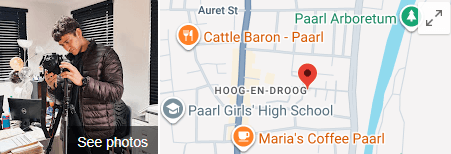
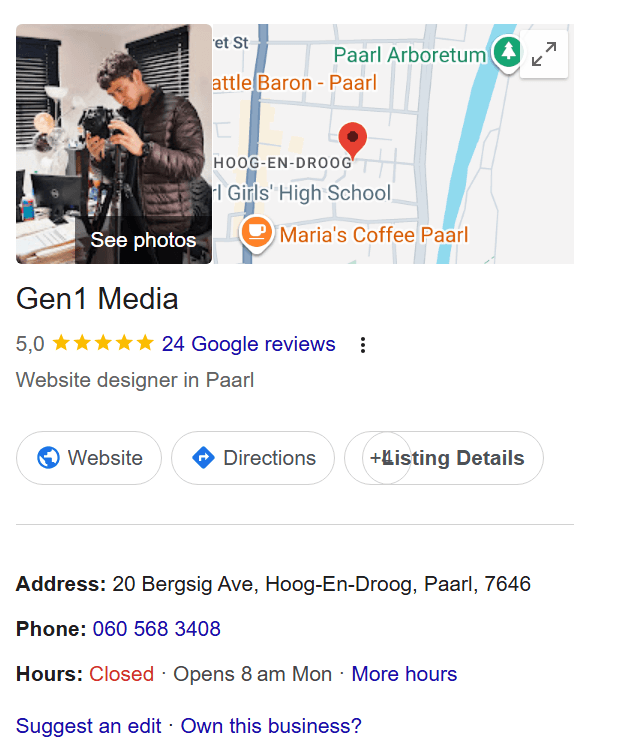
A Google Business Profile is the box about your business that appears on Google. Search for a local plumber and you get a small map with three businesses under it. Search a business by name and a panel appears on the right with its photos, star rating, phone number and opening hours. That panel is a Google Business Profile, and every business has to fill in its own.
It is free. Google does not charge for it and never has. It is also separate from your website: you can have one without the other, although the two work far better together.
If you have never heard the phrase before, you are in good company. Most business owners we meet have a profile already and have simply never logged into it.
What it actually is
Think of it as your entry in a phone book that Google keeps, except the phone book has photos, customer reviews, your opening hours, a map, a button that phones you and a button that opens your website.
You do not build it and you do not host it. Google owns the page. What you own is the right to fill it in and change it, once you have proved the business is yours.
You may hear it called Google My Business, or GMB. Same thing. Google renamed it and the old name stuck around.
Where people actually see it
Three places, and all three matter.
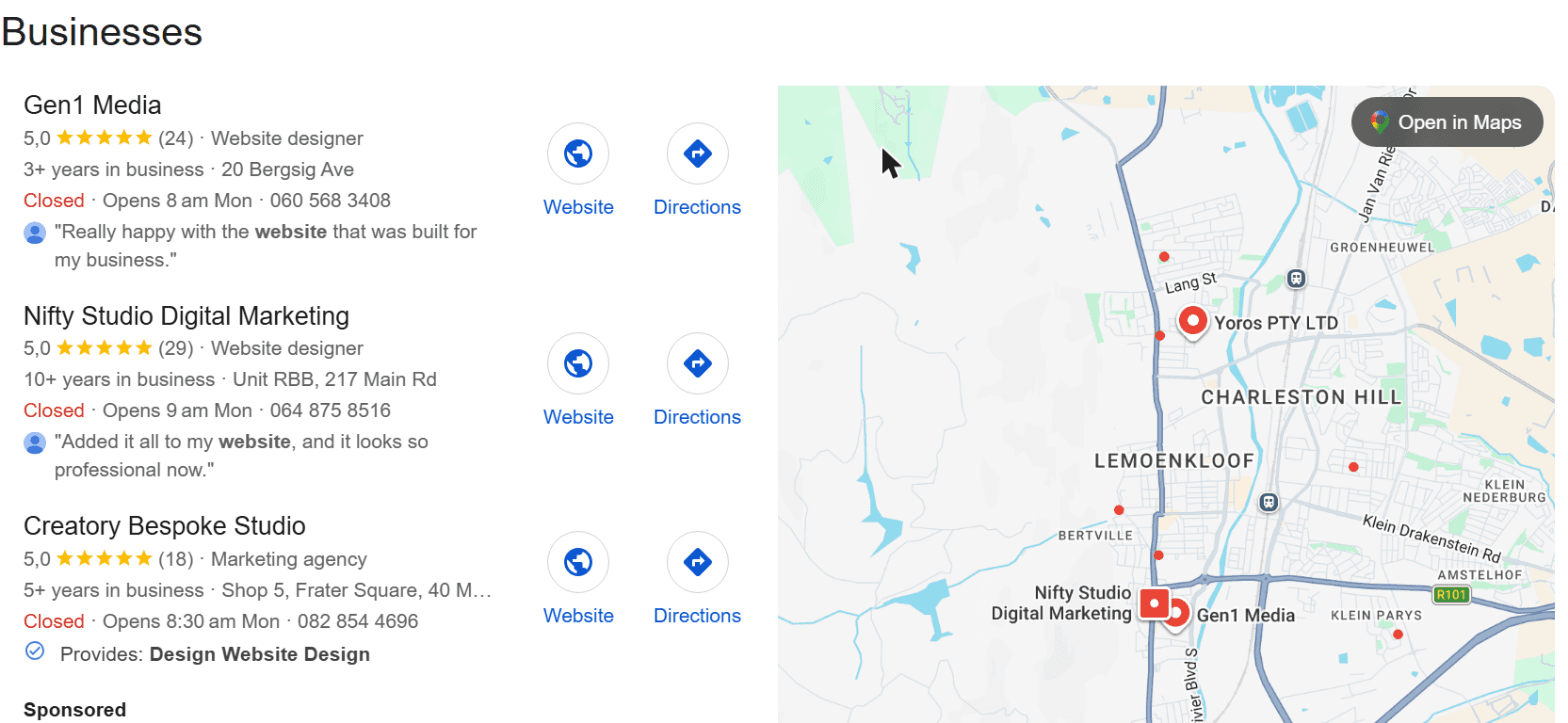
1. The map with three businesses under it
Search “plumber near me” and this is what sits at the top of the page, above the ordinary blue links. Three businesses, with stars and a Call button. Being one of those three is worth more than any other position on the page, because most people never tap past them.
2. The panel when someone searches your name
Somebody hears about you and Googles your name to check you are real. What they see is your profile: your photos, your reviews, whether you are open right now. This is the moment most people decide whether to phone, and it happens before they ever reach your website.
3. Google Maps
Someone driving through town searching for a coffee shop is using Maps, not Search. Your profile is what puts a pin on that map. No profile, no pin.
Which businesses should have one
The rule is simple. If a customer could walk into your premises, or you could drive to theirs, you need a profile. Google calls these local businesses, and the whole system is built for them.
- Plumbers, electricians, builders: you travel to the customer
- Restaurants, cafés, shops: people come to your door
- Attorneys, accountants, dentists: customers search by town
- Hairdressers, gyms, guesthouses: somebody has to find the place
- Mechanics, panel beaters, nurseries: local, physical, bookable
Not having a shopfront is not a problem. If you travel to customers you set it up as a service area business: you list the towns you cover and hide your street address, so your home address never appears publicly.
Which businesses should not bother
Not every business qualifies, and forcing it does more harm than good. Google requires a real-world point of contact: a place customers visit, or an area you travel to.
- An online-only store: no address, no service area, nothing local to rank for
- A dropshipping business: no premises and no staff a customer could visit
- An affiliate or blog site: there is no business to walk into
- A brand with no customer contact: wholesalers who never deal with the public
Worth knowing
Registering a fake address to get a listing, or using a virtual office you do not actually work from, gets profiles suspended. Recovering a suspended profile is far harder than setting one up properly in the first place.
If you sell online to the whole country, your effort belongs in your website and your product pages instead. A profile will not help you, and you will not qualify for one.
What goes on it
There are a lot of fields. These are the ones that change whether the phone rings.
Your business type
Google files every business under one main type: Plumber, Attorney, Coffee shop. This single setting decides which searches you can appear in at all, and it is the one we most often find wrong. A plumber filed as a builder will not appear when somebody searches for a plumber, no matter how good the rest of the profile is.
Reviews
The number beside your stars is the single thing customers compare. It is also the slowest to build, which is exactly why it works. If you want to know how many you actually need, we worked that out here, and replying to every one of them matters more than most owners expect.
Your website link
The button that sends people to your website. When we checked 4,366 South African businesses on Google Maps, 54% had nothing linked at all, and another 2.5% pointed at a Facebook page or a directory rather than a site they owned. If there is nothing of yours to click, Google hands that customer a map of your competitors instead.
Services, photos and hours
List every job you do as a separate service and write a sentence or two about each, mentioning the town you work in. Add about four real photos a month: the van, finished work, the team. Set your hours, including the day before a public holiday. None of this is clever. It is just the difference between a profile that looks like a working business and one that looks like it closed years ago.
You probably already have one
This surprises people. Google creates listings on its own, from other sources, without anybody asking. Customers can suggest a business too. So there may already be a page about your business that you have never seen, with an old phone number on it.
To check, Google your business name and town and look for:
- A small link saying Own this business? : a listing exists and nobody has claimed it. Claim it.
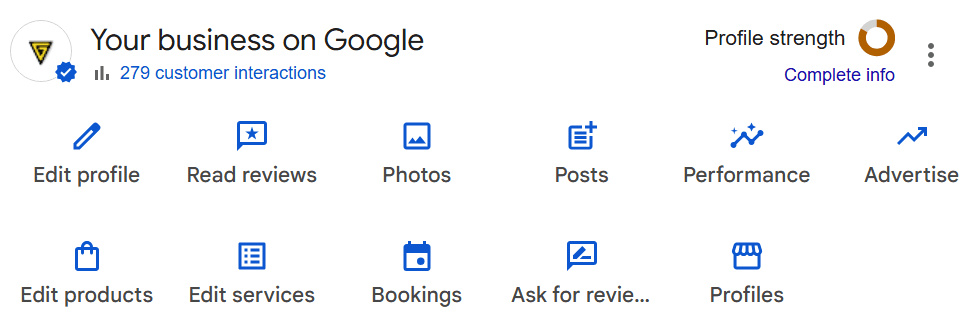
- A bar across the top saying Your business on Google : it is already yours and you are signed in.
- Nothing at all, so you need to create one, at business.google.com.
Why any of this matters
Somebody needs a plumber. They do not open a phone book or ask a neighbour. They type “plumber Paarl” into their phone and they phone one of the first three businesses they see. That decision takes about eleven seconds.
Everything about your profile is aimed at those eleven seconds. Being in the three. Having more stars than the other two. Having photos that look like a real business. Having a website button that goes somewhere.
It is free, and the whole thing takes an afternoon to set up properly. It is the highest-return hour a local business owner can spend, and most never spend it.
Common questions
Is a Google Business Profile the same thing as Google My Business?
Yes. Google renamed it. If someone tells you to set up your Google My Business, or your GMB, they mean the same thing. The old name still gets used out of habit.
Does it cost anything?
No. It is completely free, and it always has been. If someone phones you claiming you must pay Google to keep your listing active, it is a scam. Google does not phone businesses to sell them listings.
Do I need a website as well?
Yes, and the two do different jobs. Your profile gets you found; your website is where people decide whether to trust you. We checked 4,366 South African businesses on Google Maps and 54% had no website linked at all. When there is nothing of yours to click, Google sends that customer back to a map of your competitors.
Can I have one without a shopfront?
Yes. If you travel to customers, like a plumber or a mobile hairdresser, you set it up as a service area business. You list the towns you cover and hide your street address, so your home address is never shown publicly.
What if someone else set up a listing for my business?
It happens often, because Google sometimes creates listings automatically. You can claim it. Search for your business, look for the small link that says Own this business, and follow the verification steps. Until you claim it you cannot change a single thing on it.
How long does verification take?
Usually a few days. Google will ask you to prove the business is yours, most commonly by video, sometimes by post or phone. Video verification means filming your premises, signage and equipment in one unbroken take.